
Two Flexible Dosing Options for Cats
Caninsulin® (porcine insulin zinc suspension) is available in 2.7 ml cartridges, as well as 2.5 ml and 10 ml vials for injection. Caninsulin should be shaken thoroughly until a homogeneous, uniformly milky suspension is obtained.
Caninsulin
Caninsulin U-40 syringes:
This is the traditional way for insulin injection. However, care must be taken as sometimes syringes may over-deliver insulin by 25%, especially at lower doses1.

VetPen®
VetPen has been specifically designed for pets with diabetes. VetPen can provide greater and more consistent dosing accuracy1 and, compared to traditional syringes, may provide better injection comfort.
Dosing schedules
For cats, the initial recommended dose of Caninsulin (porcine insulin zinc suspension) is 1 to 2 IU per injection, given twice daily.
In cats, Caninsulin dosing is calculated on a per animal basis (initial dosing for cats is based on blood glucose results).
Caninsulin should be injected at the same time as, or immediately after feeding.
Cats should be re-evaluated at appropriate intervals and the insulin dose adjusted based on clinical signs in conjunction with appropriate lab results such as urinalysis or glucose curves until adequate glycaemic control has been attained. Alterations in dose should not normally be made more frequently than every 7 days.
Achieving effective glycaemic control
The goals of managing feline diabetes mellitus include:
- Controlling the clinical signs of hyperglycaemia (polyuria, polydipsia, weight loss and polyphagia )
- Avoiding hypoglycaemia (blood glucose <3 mmol/L)
- Obtaining blood glucose curve values in the desired range
Further adjustments in dosage may be necessary following changes in the cat's diet, body weight or concurrent medications and if the cat develops inflammation, an infection, or other medical disorder.
-
Syringe Administration
How to give Caninsulin using a U-40 insulin syringe
Use the step-by-step instructions below to teach your clients how to administer Caninsulin to their cat from the comfort of their home.
Downloadable caninsulin instructions
Important dosage information
Doses of insulin are measured in units and insulin products contain a specific number of units for every millilitre of product.
Caninsulin contains 40 International Units (IU) per millilitre (ml); 40IU/ml insulin, whereas human insulin products contain 100IU/ml. Because of this difference, to ensure pets receive the correct prescribed dose, we should only administer Caninsulin with the VetPen or U-40 syringes that are designed to measure out doses of 40IU/ml insulin.
Using anything other than U-40 syringes or the VetPen to deliver Caninsulin will result in incorrect dosing. For example, using a U-100 syringe designed to deliver 100IU/ml insulin, or a human insulin delivery pen with Caninsulin would result in significant underdosing, which could lead to instability and worsening of clinical signs. Unless they are aware, clients may attempt to replenish their syringe stock and/ or insulin supply from their local pharmacies but most pharmacists are not aware of Caninsulin, VetPen, or the U-40 syringes, nor do they stock these items.
The best way to protect pets from incorrect insulin dosing by this route is to educate pet owners on this difference and encourage them to purchase Caninsulin, U-40 syringes or the VetPen via their veterinary practice.

Administration
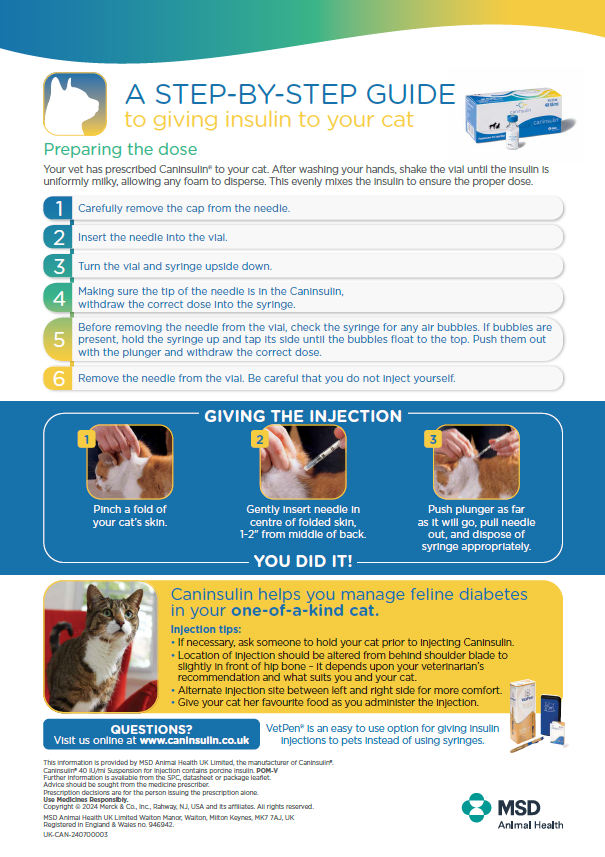
To help your clients prepare Caninsulin and correctly administer it to their cats, the following step-by-step guide will assist them through the process:
Preparing the dose
After washing your hands, shake the vial until the insulin is uniformly milky, allowing any foam to disperse. This evenly mixes the insulin to ensure the proper dose.
- Carefully remove the cap from the needle and insert the needle into the vial
- Turn the vial upside down, making sure the tip of the needle remains in the vial
- Withdraw the correct dose into the U-40 syringe
- Before removing the needle from the vial, check the syringe for any air bubbles
- If bubbles are present, hold the syringe up and tap its side until the bubbles float to the top. Push them out with the plunger and withdraw the correct dose
- Remove the needle from the vial
Injection technique
Giving injections may seem daunting for pet owners, but with practice they will become easier and part of their daily routine.
- The injection should be given under the skin, 2 to 5 cm from the middle of the cat's back. Vary the injection site from behind the shoulder blades to the middle of the back and alternate sides.
- Gently pick up a ‘scruff’ of loose skin and insert the needle into the centre.
- Push the syringe plunger until all of the insulin is delivered.
- Pull out the needle and dispose of the whole syringe into an appropriate sharps collector.
It is worth advising pet owners to alternate the injection site between the right and left side to improve comfort and deliver the best results. Repeated injections at the same site can lead to ineffective treatment.
-
VetPen Administration
Learn more about the benefits of the VetPen
The first and only insulin pen designed exclusively for diabetic pets
The Caninsulin VetPen, from MSD Animal Health, is the first and only veterinary insulin pen licensed for use in the treatment of diabetes mellitus in cats. VetPen is specifically designed to deliver accurate insulin dosing, whilst helping to improve comfort for cats, with triple sharpened silicone coated, single-use needles.
Dosing is as easy and simple as turning a dial and is a reassuring option for owners of newly diagnosed pets or for those who are nervous about injections.
VetPen is a more accurate insulin delivery device, compared to traditional syringes, especially for cats and smaller dogs1.
To avoid dosing errors, VetPen must be used with 40 IU/ml, 2.7 ml Caninsulin cartridges.
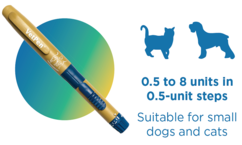
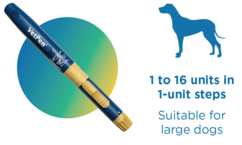
VetPen is available in 2 sizes:
- 8 IU VetPen, for cats (and small dogs) with dosing increments of 0.5 IU
- 16 IU VetPen, for larger dogs, with dosing increments of 1 IU
Caninsulin cartridges are available in boxes of 10.
It is important that pet owners DO NOT REUSE VetPen needles.
After a single use, needles should be disposed of in approved sharps or biohazard containers.
How to use VetPen
Watch the video and use the step-by-step instructions below to teach your clients how to use Caninsulin VetPen.
Content displaying is not available. Please confirm cookie policy and refresh the page.
The six simple steps of using VetPen
- Insert cartridge
- Attach needle
- Remove air bubbles*
- Select dose
- Inject dose
- Remove needle
*or priming the cartridge - only with the first use of a cartridge
Step 1: Insert Cartridge
- Wash your hands.
- Remove the cap and unscrew the body from cartridge holder.
- Ensure the plunger is retracted. If it is not, rewind plunger to retract.
- Ensure the dose selector arrow points to the start line – if not, depress the release button.
- Carefully insert the cartridge into the cartridge holder.
- Screw the cartridge holder onto the body of the VetPen
Step 2: Attach the Needle
- Carefully remove the paper tab from the outer needle
- Attach the capped needle onto the end of the VetPen by turning it clockwise until tight
- Gently invert the VetPen up and down 10 times – always mix the Caninsulin before each injection to ensure accurate dosing
Step 3: Remove air bubbles - prime the VetPen:
Before first use, it is important to remove any air from the cartridge (priming) to avoid injecting air and ensure accurate dosing.
- Remove the outer caps from the needle
- Dial one unit on the dose selector by turning the dose selector clockwise.
- Hold the VetPen vertically, ensuring the needle is pointing up.
- Push the release button, ensuring the dose selector is visible.
- A stream of insulin should be ejected from the tip of the needle. If this does not happen, air is present, repeat the process until a steady stream of insulin is seen – you may need to repeat up to 8 times before achieving this.
- Hold the VetPen horizontally and check that the cartridge is free of air bubbles. If bubbles are present, repeat the process above until the cartridge is bubble-free. NOTE: the cartridge contains two small glass beads to assist the mixing of insulin – these are not air bubbles.
- Ensure the arrow on the VetPen points to the start line on the dose selector.
The VetPen is now ready.
Step 4: Setting the dose
- Turn the dose selector clockwise until you reach the prescribed dose
NOTE: If your client suffers from arthritis or visual impairment, they can use the dose selector and release button adaptors.
Step 5: Giving the Injection:
- The injection should be given under the skin, around the shoulder blade area where loose skin is present. Alternate sites with each dose.
- Tent the skin (lift a triangle of skin with your thumb and second and third finger) and insert the needle under the skin horizontally. Keep pressing and continue to hold the injection button firmly with your thumb until the dose selector arrow returns to the start line. Then count slowly to five to ensure the dose is completely administered. You can then remove.
- Be sure to encourage owners to make a fuss of their pet, provide positive reinforcement to make the experience a positive one.
Step 6: Removing the needle
- Following the injection, remove the needle by inserting it into the needle remover and unscrewing it.
- Press the blue top on the needle remover to release, and dispose of, the used needle carefully and safely.
Changing the cartridge
Advise your client to always check the number of units left in the cartridge. If there aren’t enough for the dose, they must change the cartridge.
- Ensure the VetPen needle has been removed to prevent accidental injury.
- Unscrew the cartridge holder from the VetPen body and remove the cartridge.
- Rewind the internal plunger by holding the white lower part of the VetPen. Turn the VetPen body clockwise until the internal plunger is fully retracted. NOTE: incorrect re-winding of the internal plunger can result in damage to the VetPen.
- Return to step 1 to load the new cartridge.
Injection Tips for VetPen users
- Advise pet owners to always prepare the VetPen away from their pet.
- If they suspect only a partial dose has been given, advise not to attempt to re-dose. They should wait and give the cat its usual dose at the next injection time or contact their vet practice.
- If your clients over-dials the Caninsulin dose, they should never wind back the dose selector. Advise that they dispose of the insulin in the sink and dial up the correct dose. Dialing back the dose selector may damage the VetPen and result in inaccurate dosing.
- If insulin leaks out of the VetPen after injection, the pet owner should check for small air bubbles and NOT attempt to re-dose. If they see a couple of drops of insulin after the injection, this is normal.
- The needle should be recapped after use. Clients should not re-cap or store the VetPen with the needle attached and never re-use the needle.
- Before use, cartridges should be stored in the refrigerator at 2-8°C.
- The VetPen (loaded with the in use cartridge) can be stored at room temperature up to 25°C.
- Discard of in use cartridges 42 days from first use.
- The VetPen pouch can be used as a carry case when travelling.
-
Changes in Insulin Requirements
Caninsulin Stabilisation Protocol
Is an adjustment needed?
Insulin requirements may change suddenly, even after a long period of stability, as a result of concurrent conditions such as:
- Inflammation or infection (e.g. cystitis)
- Weight loss or gain
- Additional medications
- Other illness (e.g. renal failure, heart failure)
- Endocrine disease
- Neoplasia
In cats, dose adjustment should be managed in steps of 0.5 to 1 IU per injection twice daily changed no more frequently than once a week, especially in the first 3 weeks of initial regulation2.
The goal of insulin therapy is to maintain blood glucose concentrations below the renal threshold (which is <12-16 mmol/L) for a substantial part of the day in order to alleviate most of the cat’s clinical signs.
Monitoring patients and dose adjustment
Re-evaluate your feline patients 1 to 4 weeks after starting Caninsulin:
- Weigh the cat, assess the body condition score and modify the overall dosage of Caninsulin, in conjunction with additional clinical information, if significant weight gains or losses have occurred.
- Ask for the owner’s overall impression of the cat’s progress, especially in regard to clinical signs such as polyuria and polydipsia.
- Assess the blood glucose level to determine if stabilisation has been achieved, remember that cats often present with stress-induced hyperglycaemia.
- If needed (based on a blood glucose curve and presence of clinical signs), adjust the insulin dose in increments of 0.5 IU to 1 IU per injection twice daily.
- Allow at least 7-14 days between dose adjustments unless hypoglycaemia occurs.
- Serum fructosamine concentration can be measured in cats prone to stress hyperglycaemia before, and then 2 to 3 weeks after, any dose changes.
- Once stable and regulated on Caninsulin, cats should be rechecked every 2 to 4 months. Remember that cats, unlike dogs, can go into remission.
-
Tailoring Diets for Healthy Cats
Effective glycaemic control is dependent upon a consistent food intake. It’s important to achieve, and then maintain, a normal body weight and body condition score. A significant proportion of diabetes in cats can be attributed to being overweight or obese. Maintenance of a normal body weight and body condition score will contribute significantly to good diabetic control.
Body weight is a major factor in diet selection. Obese cats require reduced caloric intake, either through feeding a calorie-restricted, low-carbohydrate and high protein diet or a reduced quantity of their normal diet . Increasing physical activity will also benefit obese cats. In contrast, underweight cats may require calorie-rich diets such as paediatric or convalescent food.
Another important consideration is the presence of concurrent disease, for example, renal failure or pancreatitis. In some cases, dietary management for associated problems is more critical than a specific diabetic diet. Also, any concurrent infection, inflammation, hormonal disorder or neoplastic condition can interfere with insulin therapy.
The dietary management of cats with diabetes3
Weight Control
- The average daily caloric intake for a diabetic cat should be 30–50 kcal/kg – check with food manufacturer
- Adjust daily caloric intake on an individual basis
- If required, eliminate obesity by feeding diets designed for weight loss or reducing the quantity of the cat’s usual food
Feeding recommendations
- Cats are obligate carnivores and naturally require a low carbohydrate, high-protein diet
- The diet needs to be tailored to a cat’s individual needs, although high-protein, low-carbohydrate foods are ideal for many cats with diabetes
- Canned or dry foods can be selected, but canned foods are preferred as they tend to be lower in carbohydrates
NOTE: It is important that the cat willingly and consistently eats any recommended diet, so food must be palatable.
Meal timing
For twice-daily Caninsulin dosing of cats:
- Keep the caloric content of meals consistent
- Maintain a consistent feeding schedule
- Feed the cat as usual (unless it has been identified that the pet is over-fed in which case, feed in line with requirements in order to attain a healthy weight). If is the cat is fed twice daily, Caninsulin should be injected at the same time as, or immediately after feeding.
-
Starting Regulation with Caninsulin
When health status is known and diagnosis is confirmed
- Explain ‘what is diabetes mellitus’ to the cat’s owner and that achieving stabilisation may take time (up to 6 months ) as well as any implications for the family. Make sure they understand the therapy involved and that the cat should be able to live a happy, healthy life with consistent therapy. This is crucial, as complete cooperation of the owner is essential to successful management.
- Treat existing infections or other medical conditions. Many diseases will affect insulin metabolism.
- Introduce an appropriate diet which is palatable to the cat.
- Begin therapy with Caninsulin (porcine insulin zinc suspension).
Starting Caninsulin in clinic
Determine the owner-preferred method of administration
Caninsulin is available in two presentations, to enable vets and owners to discuss what might be right for them.
Vetpen is the first and only insulin pen to deliver 40 IU/ml insulin via 2.7 ml cartridges. This method is more accurate than the traditional syringe approach and is easy to use.
Caninsulin is also available in 2.5 ml and 10 ml vials for use with specific 40 IU syringes.
Steps to begin therapy
- Weigh and body condition score the cat to obtain a benchmark for future weight gain or loss.
- Start the cat on 1 to 2 IU per injection given twice daily. In cats, Caninsulin dosing is calculated on a per animal basis (initial dosing for cats is based on blood glucose results). Administer the injections at the same time as, or right after meals for cats fed twice daily. No change in feeding schedule is needed for grazing cats.
- Perform a blood glucose curve on the day of starting insulin to verify that the starting dose will not cause hypoglycaemia.
- Instruct the owner on:
- How to administer injections
- How to identify and treat hypoglycaemia
- Parameters to monitor at home
- Preferred diet and frequency of meals
- Discharge the cat to their owner’s care for 7 to 21 days. This allows the cat and owner time to get used to the injection regimen.
At home, ask the owner to:
- Monitor and record water and food consumption.
- Advise the owner to use the PetDiabetes Tracker app UK, available free from the iOS and Google play
- Maintain the Caninsulin starting dose and frequency of administration for 7 to 21 days, unless there is evidence of hypoglycaemia.
- Bring the cat in for re-evaluation 7-21 days after starting Caninsulin, or earlier if clinical signs of hypoglycaemia develop.
-
Problems with Stabilisation
For cases with poor glycaemic control
Ruling out underlying disorders
- Review the owner’s diary and spend time discussing the cat’s lifestyle.
- Assess the owner’s injection technique– correct if necessary. If using a VetPen, ensure the owner understands how to dial-up and administer the correct dose.
- Conduct a full clinical examination to determine which tests (other than a blood glucose curve) are required.
- Develop a blood glucose curve and check for other concurrent diseases such as acromegaly, hyperthyroidism and pancreatitis.
- Discuss the daily routine with the cat owner - are injection timings and meal quantities and type consistent?
- Ask for a breakdown of the cat’s regular diet (including snacks), to ensure it is consistent and based on high protein and low carbohydrate rations wherever possible, dependent on concurrent conditions. Remember, many outdoor cats will hunt, and owners might not know exactly what they are eating.
Factors thought to contribute to a poor response to insulin treatment
- Incorrect storage of insulin or poor injection technique
- Insulin resistance
- Somogyi effect
- Rapid metabolism of insulin
In cases of a poor response to insulin therapy, it is initially important to rule out the following:
Incorrect storage of insulin or poor injection technique
In cases of a poor response to insulin therapy, it is initially important to rule out the following:
Ask owners to demonstrate how they inject their pet and check:
General questions:
- Is the insulin being stored correctly?
- Is the insulin being mixed properly?
- Is the insulin being injected subcutaneously?
- Is the injection site being correctly located?
- Is the injection site being rotated?
If using a syringe:
- How long has the vial been in use?
- Is the correct dose being drawn up into the syringe?
- Is a new syringe being used for each injection?
- Are the air bubbles being removed from the syringe during dose measurement?
If using VetPen:
- Have the VetPen and cartridges been stored correctly?
- Is the insulin cartridge inserted into the VetPen properly?
- Have any air bubbles been removed from the VetPen cartridge?
- Is a new needle being used for each injection?
- Is the correct dose being chosen using the dose selector?
- Is the release button being pushed down fully so that the dose selector returns to the start line?
- Is the movement of the dose selector restricted by the way the VetPen is being held?
- Is the needle being held in the skin for at least 5 seconds after the dose selector has returned to the start line?
See proper handling and storage and delivery of Caninsulin for more information
-
Long-term Management
Use our blood glucose curve generator
Maintaining stable diabetic cats
Help clients understand that with proper care their cats can live healthy, active lives.
Monitoring
Once the maintenance dose has been established and the cat is stable, a long-term management program must be implemented. The aim is to minimise variations in insulin requirement. This includes monitoring to detect underdosage or overdosage of insulin and dose adjustment, if required. Careful monitoring will help to detect, and limit, any potentially chronic problems associated with diabetes. Pet owners should be encouraged to monitor and record their cat's general health (including well-being, thirst, and appetite) and keep a diary of all clinical signs.
After the maintenance dose of Caninsulin (porcine insulin zinc suspension) has been established based on the blood glucose curves, cats can be rechecked less frequently, every 2 to 4 months (weekly if clinical signs reappear) for general health, urine glucose, and blood glucose levels, if indicated by changes general health and diary information from the owner. If there is a sudden return of polyuria (PU), polydipsia (PD), or polyphagia, appropriate follow-up tests such as a glucose curve or fructosamine analysis should be performed.
Blood glucose curves
Blood glucose curves (BGCs) are a useful tool in the stabilisation of diabetic cats. They give an accurate assessment on which to base changes in insulin therapy and are vital in investigating the unstable diabetic. They help to determine insulin effectiveness, duration of action, the correct insulin dose and the maximum and minimum glucose concentrations.
Use our glucose curve generator
After hospitalisation of the cat, blood samples should be taken before the first insulin injection of the day and then every two to four hours, if possible, for 24 hours – although this is often not practical in practice and 10-12 hours may be more realistic. If a Somogyi over-swing is suspected, samples should be taken every hour. Ideally the cat’s normal feeding and insulin regime would be continued.
The goal is to maintain blood glucose concentrations below the renal threshold (11.1-15.6 mmol/L in cats).
Contraindications for creating a BCG are:
- Concurrent administration of drugs affecting glycaemia
- Presence of a known infection or disease
- A stressed animal
Fructosamine
Because the albumin, to which fructosamine binds, degrades in the body every 14 to 21 days, serum fructosamine levels reflects the average blood glucose concentration over the previous 1 to 3 weeks. Fructosamine levels in the cat are not affected by insulin or stress factors, so they can be taken any time of the day and only a single sample is required, however there are limitations:
- Fructosamine analysis will not detect short term or transient abnormalities, such as transient daily episodes of hypoglycaemia (which would require blood glucose analysis) or Somogyi overswing, requiring serial measurement of blood glucose concentrations.
- Hyperthyroid cats with concurrent diabetes mellitus may have decreased fructosamine levels because of an increase in the protein turnover rate (decreased protein half-life) resulting from increased thyroid hormone concentrations. It is important to rule this condition out or ensure it is well managed.
- Dehydration is not uncommon in cats with unregulated diabetes, and this can lead to the appearance of hyperproteinaemia and higher than expected fructosamine values. Dehydration should be corrected before evaluating serum fructosamine levels.
- Globulin and fructosamine concentrations are correlated in cats. Hypoglobulinaemia will result in decreased fructosamine concentration—the laboratory performing the analysis should be consulted as to whether a correction is required and whether this has been done.
Urine monitoring
A urine sample will only test positive for glucose if the blood glucose concentration remains above the renal threshold for a substantial period of time. Therefore, urine monitoring is not a very reliable method by which to adjust a cat's insulin dose and should only be used when it’s impossible to take blood samples or to monitor for ketones in the urine.
Clinical signs
If a patient shows signs of dysregulation, such as PU, PD or polyphagia, a full clinical examination is required, alongside a blood glucose curve. It is extremely important that owners can recognise the signs of hypo- or hyperglycaemia and respond appropriately. PU, PD or polyphagia accompanied by weight loss, poor condition, loss of hair, hirsutism or lethargy are the most common clinical signs of hyperglycaemia.
However, these clinical signs may also be present as a result of a rebound hyperglycaemia secondary to a hypoglycaemic episode (Somogyi overswing). While a blood glucose curve can help differentiate between insufficient insulin dosing and Somogyi overswing, the results can be confusing if the rebound hyperglycaemia persists for a few days. Evaluating weight and body condition score changes in the patient can help shed some light. If the cat is losing weight / body condition and exhibiting clinical signs of diabetes mellitus, the insulin dose may be insufficient. If the cat is gaining weight / body condition but continues to have clinical signs consistent with diabetes mellitus, the insulin dose may be excessive, and causing Somogyi overswing.
Remember that blood glucose curves at the clinic only approximate how the cat responds to insulin at home. Feeding and exercise patterns are different, and stress (especially in cats) can alter the glycaemic response. It is therefore critical to take into account clinical signs (or lack thereof) when any change in insulin therapy is considered and always in conjunction with laboratory test results. The ultimate goal in regulating a cat with diabetes is to control the clinical signs adequately.
Owners should understand that their cats can live healthy, active lives when diabetes is properly regulated. They should also know that cats usually require lifelong treatment with an insulin preparation, although some may go into clinical remission.


Caninsulin® 40 IU/ml Suspension for Injection contains porcine insulin. POM-V
Further information is available from the SPC, datasheet or package leaflet.
Advice should be sought from the medicine prescriber.
Prescription decisions are for the person issuing the prescription alone.
Use Medicines Responsibly.
MSD Animal Health UK Limited, Walton Manor, Walton, Milton Keynes, MK7 7AJ, UK
Registered in England & Wales no. 946942
References
- Burgaud, S., Riant, S. & Piau, N. (2012). Comparative laboratory evolution of dose delivery using a veterinary insulin pen. Proceedings of the WSAVA/FECAVA/BSAVA Congress, Birmingham UK. 12-15 April 2012. Abstract 499
- Caninsulin Summary of Product Characteristics (SPC)
- Behrend E, Holford A, Lathan P et al. AAHA Diabetes Management Guidelines for Dogs and Cats. J Am AnimHosp Assoc. 2018; 54:1–21.


