
The Evolution of PCV-2
Learn about the evolution of PCV-2 and how vaccines are still able to tackle the disease.
Porcine circovirus is a widespread disease that was first discovered in the late 2000s, but it is thought to have been circulating in pig populations for much longer without causing disease. The disease is spread by contact with infected pigs and is characterised by wasting, increased mortality and overt weight loss in growing and fattening pigs.
This disease was a devastating disease for commercial units before vaccinations as the revenue lost from decreased weight gain and mortality was significant.
Vaccination, however, was revolutionary as it put a stop to this and allowed pigs to reach their weight potential.
PCV-2 vaccines were first brought to the market in the UK over 10 years ago, revolutionising pig production with their efficacy.
Since this time, many vaccines for the control of PCV-2 have been brought to market including Porcilis® PCV Emulsion for injection for pigs.
All of the vaccines on the market have been shown to be very effective in regulatory and field trials as well as on-farm.
Comparative studies for the effectiveness of PCV-2 vaccines
A study in 2011, carried out at the University of Minnesota, measured PCV-2 vaccines side-by-side and found no significant differences between the vaccines1.
“It was concluded that PCV-2 vaccines reduced viremia and improved weight gain, but difference in weight gain among vaccinated groups were not statistically different.”
Two meta-analyses of PCV-2 vaccines in 20132 and 20143 found very similar results to this study. They found that the vaccines were not different in terms of efficacy.
After several years of these vaccines being available to pig producers and being used widely across the globe, it’s clear that they are still very effective.
Does the timing of vaccination make a difference?
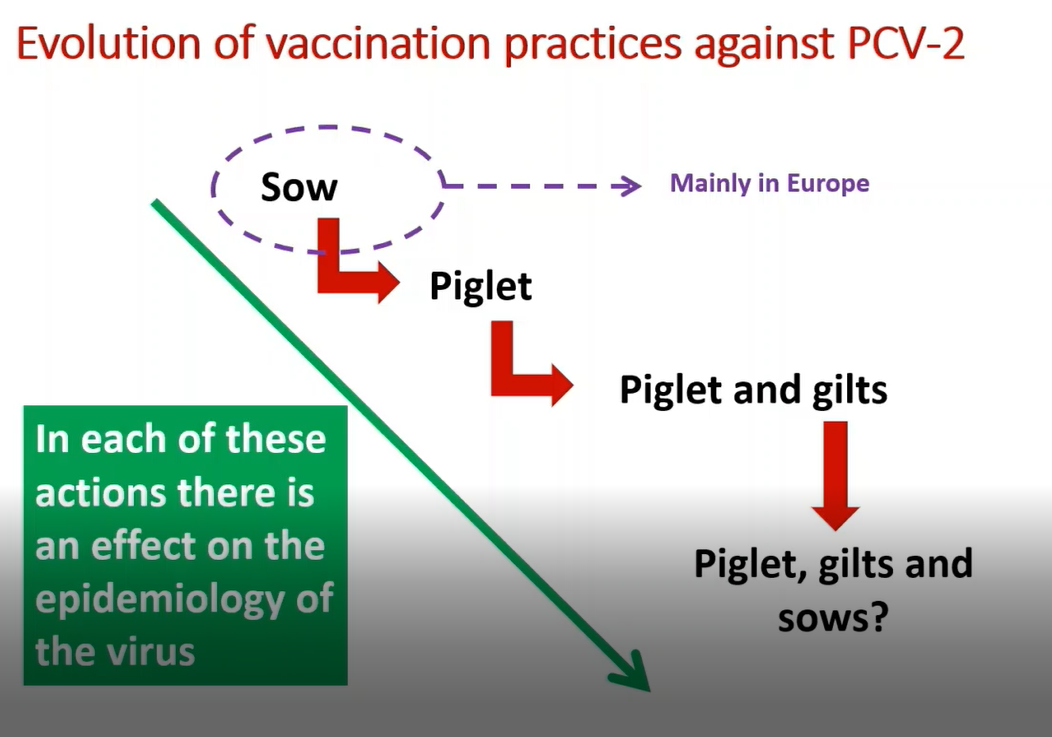
As commercial vaccines were highly efficacious in stopping viral infections and virus circulation in a population, every vaccine program had an effect on the epidemiology of the virus, leading to different scenarios currently and time of infection.
Years ago, infections in the postweaning period were very common. Nowadays as most of the piglets are vaccinated, we may detect few infections around weaning, but a slight increase of reproductive failure in sows, leading to early infection before piglets are vaccinated.
Do vaccines work against all PCV-2 genotypes?
Because of the evolution of the virus and various other factors, PCV-2 genotypes have evolved over the years.
There are two classical genotypes of PCV-2:
- PCV-2a – was the first genotype detected and is associated with early sporadic infections.
- PCV-2b – is associated with the most significant outbreaks of PCV-2 systemic disease (SD) all over the world.
There was a clear genotype shift from a more sporadic disease (PCV-2a) to a virulent and epidemic level disease outbreak with the shift to PCV-2b.
The most common genotype that is seen nowadays is PCV-2d.
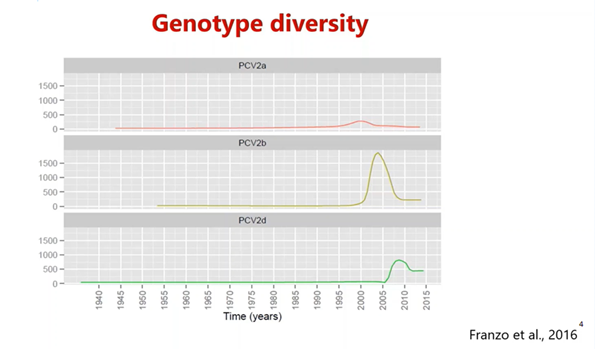
This graph shows the genotype shifts that were explained above. You can see a shift from PCV-2a to PCV-2b around 2000 and a shift from PCV-2b to PCV-2d in 2010.
When PCV-2d was initially seen it was wrongly linked to potential cases of vaccination programme failure, however it was demonstrated through research that vaccines based on PCV-2a genotype were able to protect against this genotype. Later it has been shown that these cases were associated with a shift of the virus epidemiology on farm and a lack of correct design of the vaccination program.
Most importantly, the difference in virulence among genotypes has not been demonstrated. According to recent studies, there is no evidence indicating that any of PCV-2d and other new genotypes are more infectious or virulent than the previous ones (PCV-2b).
A study carried out by Giovanni Franzo and Joaquim Segales in 20205 found that: ‘Although genotype variability is likely to increase in the future, current data indicates that cross-immunity is present among major genotypes (PCV-2a, PCV-2b and PCV-2d) which, to date, guarantees vaccine induced protection by those products based on PCV-2a.’
Prof. Dr. Segales says that any vaccine based on PCV-2a will protect equally against PCV-2d and PCV-2b.
It is clear from the research above that although these vaccines have been around for many years, they remain effective, even today in the face of the evolution of new genotypes.
Porcilis® PCV M Hyo contains Porcine circovirus type 2 ORF2 subunit antigen
and Mycoplasma hyopneumoniae J strain inactivated. POM-V.
Further information is available from the SPC, datasheet or package leaflet.
Advice should be sought from the medicine prescriber.
Prescription decisions are for the person issuing the prescription alone.
Use Medicines Responsibly.
MSD Animal Health UK Limited, Walton Manor, Walton, Milton Keynes, MK7 7AJ, UK
Registered in England & Wales no. 946942
References
1. Comparative efficacy of three commercial PCV2 vaccines in conventionally reared pigs, KwangSoo Lyoo, HanSoo Joo, Brian Caldwell, HyeunBum Kim, Peter R Davies, Jerry Torrison, University of Minnesota, 2011
2. A meta-analysis comparing the effect of PCV2 vaccines on average daily weight gain and mortality rate in pigs from weaning to slaughter, Charlotte Sonne Kristensen, Niels Peter Baadsgaard, Nils Toft, 2013
3. Mixed treatment comparison meta-analysis of porcine circovirus type 2 (PCV2) vaccines used in piglets, N. da Silva, A. Carriquiry, K O’Neill, T. Opriessnig, A.M. Connor, 2014
4. Franzo et al., 2016
5. Porcine circovirus 2 genotypes, immunity and vaccines: multiple genotypes but one single serotype, Giovanni Franzo and Joaquim Segales, 2020


