
Bovine Coronavirus (BCoV) and the Respiratory System
Bovine Coronavirus (BCoV) and the
Respiratory System
Calf pneumonia or Bovine Respiratory Disease (BRD) is a complex, multi-factorial disease which results in inflammation and damage to the tissues of the lungs and respiratory tract. It is one of the most common and costly diseases in young calves, having a long-term impact on productivity in both dairy and beef systems.1,2,3
-
BRD Impact on Dairy Systems
BRD is the most common cause of death and poor performance in dairy cattle under one year4 with 14.5% of dairy heifers failing to reach 1st lactation.5
- 525 kg decrease in first lactation milk production.2
- 30 day increase in time to 1st calving.4
- Reduction of bodyweight at 14 months of 29 kg.4
-
BRD Impact on Beef Systems
More than 70% of cattle had lung damage at slaughter despite only 35% being treated for BRD.6
Calves with a BRD history have:
- Decreased growth performance (up to 6 kg/month).7
- Longer fattening period (+33 to 59 days).7
Analysis of UK BRD diagnostics indicates Bovine Coronavirus (BCoV) is the most reported virus identified on-farm in routine screening & in the face of an outbreak.
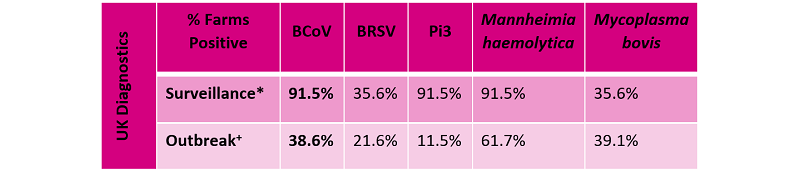
* Calf serology from 59 farms across UK which have had history of BRD issues (2021-2022)
+ Nasal Swab PCR from 407 farms submitted to Biobest (2020-2022)
Additionally, a 16-country European study found every farm was seropositive for BCoV & herds containing BCoV-seropositive calves had an increased risk of suffering BRD outbreaks.8
-
BCoV Background
Pneumoenteric RNA virus commonly found on farms across the world causing calf diarrhoea, respiratory disease & winter dysentery.9
Infection via faecal-oral route or aerosol inhalation; regardless of infection route, virus is shed in both faecal & nasal secretions.9
The respiratory & enteric forms are antigenically & genetically identical.10
-
Role of BCoV in BRD
BCoV is a primary BRD pathogen which opens the door to other pathogens:
- It disturbs the 1st line of defence – the protective mucus layer.11
- It enhances bacterial adherence to respiratory epithelia by upregulating expression of bacterial adhesion molecules.12
BCoV is frequently isolated alongside other pathogens such as M. haemolytica, M. bovis & Pi3; suggesting an interplay between these pathogens.10,13
-
BCoV Transmissibility
BCoV is incredibly widespread due to these 3 key reasons:
- Carrier animals: Asymptomatic (carrier) animals shed the respiratory and enteric virus which serves as a source of infection to other animals on the farm.14
- Shedding: Peak clinical signs (respiratory rate/fever) appear more than a week after shedding starts.15
Fomite transmission: Infective BCoV was found on rinsed & visually clean fomites (clothes, boots, wristwatches & stethoscopes) after 24h indicating they could be vehicles for transmission.16
-
BCoV On-Farm Risk Factors
The following key risk factors are significantly associated with respiratory BCoV issues:17
- Detection of BCoV (in diarrhoeic calves).
- Detection of M. haemolytica on the farm.
- Purchase of colostrum.
- Recent purchase of cattle.
BCoV has also been found as a co-infective agent in 72% of M. bovis positive outbreaks.17
Farms which have positive respiratory diagnosis or at least one of these risk factors could benefit from a specific BCoV prevention plan.
CLOSING THE DOOR ON BOVINE RESPIRATORY DISEASE THROUGH BCoV VACCINATION
BCoV is traditionally associated with enteric disease, however this information highlights its importance within the BRD Complex.
Based on BCoV’s ability to disturb the critical mucus lining of the respiratory tract which opens the door to secondary BRD pathogens and its high on-farm prevalence, this is a pathogen which should be included in farm disease prevention plans.
Colostral protection against BCoV is important for enteric infection but protection derived from colostrum has minimal impact on immunity at the nasal mucosa,18 therefore intranasal vaccination is a key tool to help protect against respiratory BCoV.
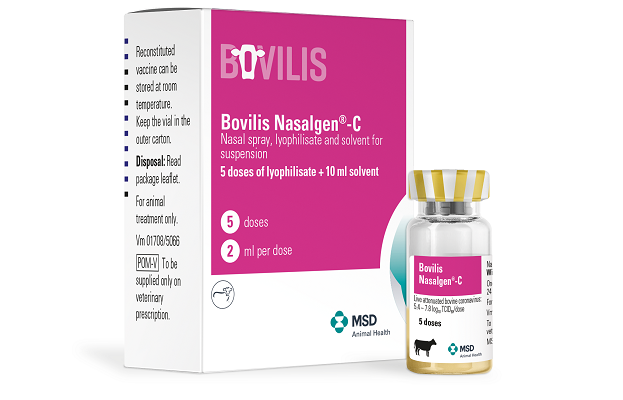
BOVILIS NASALGEN®-C - UNIQUE BCoV VACCINE PROTECTION
A live intranasal vaccine used for the active immunisation of cattle from the day of birth onwards to reduce clinical signs of upper respiratory tract disease and nasal viral shedding from infection with bovine coronavirus.
Bovilis Nasalgen-C Product Information
Bovilis Nasalgen-C Product FAQs
BCoV and our Respiratory Solution
Book a visit to your vet practice!
BCoV e-Book
Download our BCoV e-book!
Product images are representations of packaging and may not accurately reflect the current packaging available in the GB marketplace.
Bovilis Nasalgen®-C contains live bovine coronavirus, strain CA25. POM-V.
Bovilis® INtranasal RSP™ Live contains live BRSV and Pi3. POM-V.
Bovilis® Bovipast® RSP contains inactivated BRSV (strain EV908), Pi3 virus (strain SF-4 Reisinger) and inactivated Mannheimia (Pasteurella) haemolytica (serotype A1). POM-V.
Bovilis® IBR Marker Live contains live bovine herpesvirus type 1 (BHV-1), strain GK/D (gE¯)*: 105.7 - 107.3 TCID50**. *gE¯: glycoprotein E negative. **TCID50: tissue culture infective doses 50%. POM-V.
Bovilis® Huskvac contains viable Dictyocaulus viviparus 3rd stage irradiated larvae. POM-V.
Further information is available from the SPC, datasheet or package leaflets.
Advice should be sought from the medicine prescriber.
Prescription decisions are for the person issuing the prescription alone.
Use Medicines Responsibly.
MSD Animal Health UK Limited, Walton Manor, Walton, Milton Keynes, MK7 7AJ, UK
Registered in England & Wales no. 946942

References
1. NADIS (http://www.nadis.org.uk/bulletins/respiratory-disease-in-dairy-and-beef-rearer-units.aspx)
2. Dunn et al. (2018) The effect of lung consolidation, as determined by ultrasonography on first-lactation milk production in Holstein dairy calves, J. Dairy Sci., 101: 1-7.
3. Delabouglise et al. (2017) Linking disease epidemiology and livestock productivity: The case of bovine respiratory disease in France. PLoS ONE 12(12): e0189090.
4. Brickell et al. (2009) Mortality in Holstein-Friesian calves and replacement heifers, in relation to body-weight and IGF-I concentration, on 19 farms in England. Animal. 3(8):1175-82.
5. Andrews (2000) Calf pneumonia costs. Cattle Practice Vol 8 Part 2, 109-114.
6. Wittum et al. (1996) Relationships among treatment for respiratory tract disease, pulmonary lesions evident at slaughter and rate of weight gain in feedlot cattle. J. Am. Vet. Med. Ass. 209.
7. Williams & Green (2007) Associations between lung lesions and grade and estimated daily live weight gain in bull beef at slaughter. Cattle Practice, Vol.15 (No.3). pp. 244-249.
8. Berge & Vertenten (2022) Prevalence, biosecurity & risk management of coronavirus infections on dairy farms in Europe. World Buiatrics Congress, Madrid, Spain.
9. Hodnik et al. (2020) Coronaviruses in cattle. Trop Anim Health Prod. 2020 Nov;52(6):2809-2816.
10. Saif (2010) Bovine respiratory coronavirus. Vet Clin North Am Food Anim Pract. Jul;26(2):349-64.
11. Caswell (2014) Failure of respiratory defenses in the pathogenesis of bacterial pneumonia of cattle. Vet Pathol. Mar;51(2):393-409.
12. Fahkrajang et al. (2021) Bovine respiratory coronavirus enhances bacterial adherence by upregulating expression of cellular receptors on bovine respiratory epithelial cells. Vet Microbiol. Apr;255:109017.
13. Pardon et al. (2020) Pathogen-specific risk factors in acute outbreaks of respiratory disease in calves. J Dairy Sci. Mar;103(3):2556-2566.
14. Vlasova & Saif (2021) Bovine Coronavirus and the Associated Diseases. Frontiers in Veterinary Science. 8
15. Oma et al. (2016) Bovine coronavirus in naturally and experimentally exposed calves; viral shedding and the potential for transmission. Virol J 13, 100.
16. Oma et al. (2018) Temporary carriage of bovine coronavirus & bovine respiratory syncytial virus by fomites & human nasal mucosa after exposure to infected calves. BMC Vet Res. Jan 22;14(1):22.
17. Pardon (2011) Prevalence of respiratory pathogens in diseased, non-vaccinated, routinely medicated veal calves. Vet Rec. Sep 10;169(11):278.
18. Nuijten et al. (2019) A new intranasal BRD vaccine induces protection in the presence of maternally derived antibodies. European Bovine Congress.


